

For most businesses, the internet connection is invisible right up until it isn’t. Point-of-sale systems freeze, VoIP calls drop, cloud applications stop syncing, and a workday that seemed ordinary suddenly grinds to a halt. The financial impact of that moment is larger than most owners assume — and it’s why a growing number of businesses are treating internet resilience the same way they treat backup power or data backups: as a baseline requirement, not an optional upgrade.
The Real Cost of Going Offline
Downtime costs vary widely by company size and industry, but the financial impact can be substantial.
Business.com, citing industry data from Sherweb, reports that small-business downtime can cost between $127 and $427 per minute—meaning a three-hour outage could amount to roughly $22,500 to $77,000 (Business.com). At the enterprise end, Splunk’s 2026 Hidden Costs of Downtime research, conducted in
partnership with Oxford Economics, puts the average cost of downtime at approximately $15,000 per minute, with unplanned outages and service degradation costing Global 2000 companies a combined $600 billion annually (Splunk, 2026; Gatling, 2026). Even older, more conservative Gartner figures — often cited at $5,600 per minute — still work out to well over $300,000 for a single hour (Atlassian).
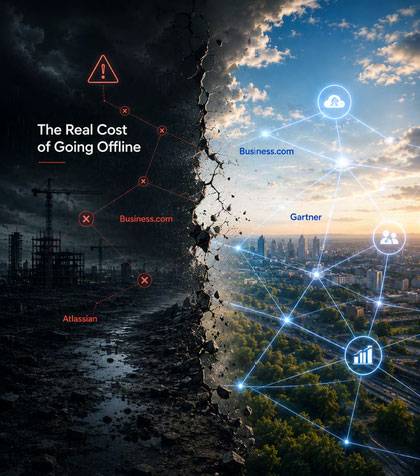
Those numbers aren’t just about lost sales. They include idle payroll, missed customer commitments, and the slower-moving damage of reputation and customer churn. For a small consulting firm billing $150 an hour with five people on staff, an hour of downtime can mean $750 in lost billable time before a single client complaint comes in (Business.com).
Why a Single Connection Is a Single Point of Failure
How Fixed Wireless Access Fills That Role
Equipment vendors in this space, including Global Telecom Engineering, build CPE specifically around this use case. The company’s TITAN 5100, for example, is marketed as a 5G fixed-wireless router with automatic, dual-SIM failover and industrial-grade construction intended for continuous, unattended operation (Global Telecom Engineering).
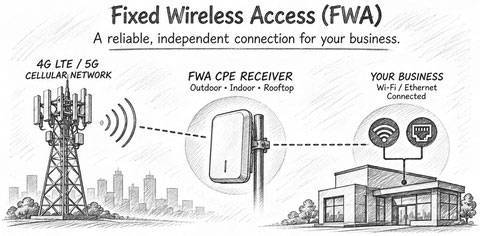
Global Telecom also pairs its hardware with an Intent-Based Connectivity Optimization platform that continuously steers connected devices toward the strongest, least-congested cell sector available, which is a separate layer from carrierlevel failover but works alongside it to keep performance consistent (Global Telecom Engineering).
One example of this approach packaged as a dedicated service is TITANS Network, a connectivity brand powered by Global Telecom Engineering. In February 2026, the company announced enhanced FWA failover capabilities aimed at business and residential customers, describing a system that continuously monitors the primary connection and automatically switches to a backup path during outages, severe weather, or network disruptions, without requiring manual intervention (Business Wire). It’s a useful illustration of what a purpose-built failover offering looks like in practice, though businesses evaluating any provider should confirm current specifications, coverage, and pricing directly, since offerings in this space change quickly.
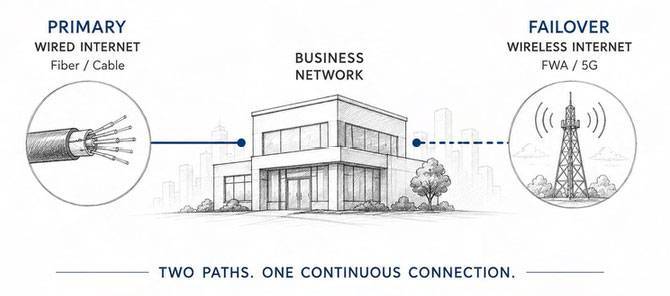
Primary and Failover, Working Together
The Bottom Line
Connectivity has quietly become as foundational to running a business as electricity or water — and, like those utilities, it benefits from redundancy. A wired primary connection paired with a wireless failover path, delivered through FWA CPE, gives businesses a practical, increasingly affordable way to make sure a single point of failure doesn’t become a full-day (or full-cost) outage.
NAROTHUM SAXENA
VP of Emerging Technologies
Global Telecom Engineering | TITANS Network
References
- Atlassian. (n.d.). Calculating the cost of downtime. Atlassian. atlassian.com/incident-management/kpis/cost-of-downtime
- Business.com. (2026, April 28). The real cost of internet downtime for small businesses.
- Chen, C., Kedem, O., da Silva, C. R. C. M., & Cordeiro, C. (2019). Millimeter-wave fixed wireless access using IEEE 802.11ay.
- Du, J., Chizhik, D., Feick, R., Castro, G., Rodriguez, M., & Valenzuela, R. A. (2018). Suburban residential building penetration loss at 28 GHz for fixed wireless access.
- Global Telecom Engineering. (n.d.). Fixed wireless and IoT solutions. glob-tel.com
- Global Telecom Engineering. (n.d.). TITAN 5100. glob-tel.com/titan-5100
- Global Telecom Engineering. (n.d.). TITAN 5100 product sheet. TITAN 5100 product sheet
- Oxford Economics & Splunk. (2024). The hidden costs of downtime: The $400B problem facing the Global 2000. Oxford Economics.
- Sun, C., & Radenkovic, M. (2024). An investigation of software-defined wide-area networking (SD-WAN) for optimizing multi-site enterprise networks.
- TITANS Network. (2026, February 3). TITANS Network launches advanced fixed wireless failover solution for always-on connectivity [Press release]. Business Wire.