

How wireless connectivity turns the manual steps of cell-site and fiber construction into a realtime, digital workflow
THE PROBLEM
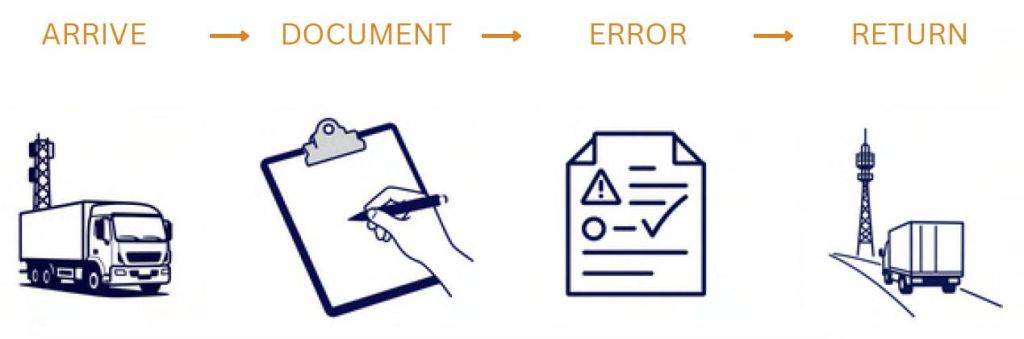
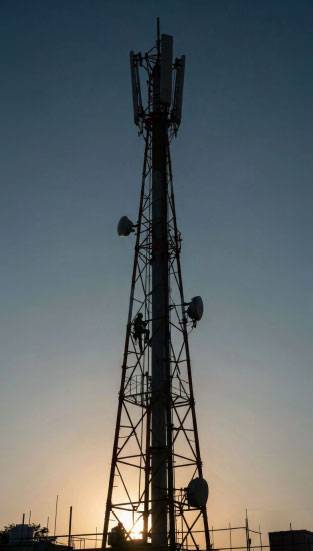
Strip away the marketing, and cell-site and fiber construction are the same shape: a chain of site visits, most of them single-discipline, most of them documented on paper and a phone camera. A crew shows up, does the work, writes it down, and drives away. The mistake — a few degrees of azimuth, a missing serial-number photo, a splice that isn’t tied to a map — surfaces days or weeks later, at close-out or during an outage. Fixing it means sending someone back. That return trip is the tax the whole industry pays, and closing the gap that creates it is the entire point of digitizing the work. The catch is that every digital tool depends on the site being connected in real time, which is exactly what tends to be missing. Here is the problem in each trade, and then the fix.
Example 1
Cell-site construction
Example 2
Fiber / outside-plant (OSP) construction
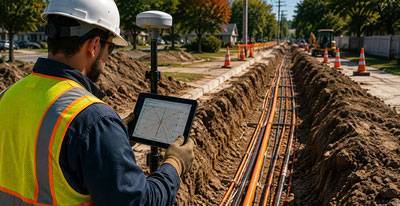
Fiber is the same story, mostly underground, where a mistake is invisible until something breaks. It begins with high-level design — and when three to five people hand-draw it, the plans disagree, and the field pays for it. Detailed design turns that into prints that field discoveries force into redraws. Then permitting, make-ready, and 811 locates: thousands of permits by jurisdiction, pole loading analysis, joint-use coordination, and paint-and-flag utility marks before anyone digs. On the walkout, crews collect pole data with laser and GPS on paper sheets that get re-keyed in the office.
During construction, crews arrive with plans that no longer match; cable placement logs reel IDs and footage on paper; splicing is recorded on a paper matrix whose events aren’t tied to a map, so the network has to be rediscovered later. Testing means bidirectional OTDR traces compiled by hand, and the as-built is redlined on paper and transcribed into the GIS, where traditional QA can only spot-check a fraction of the work before turn-up stalls because the records don’t match the plant. In both trades the pattern is identical: the work is captured on paper at the point of work, and the errors it hides are found far downstream, when they are expensive to fix.
THE FACTS BEHIND IT
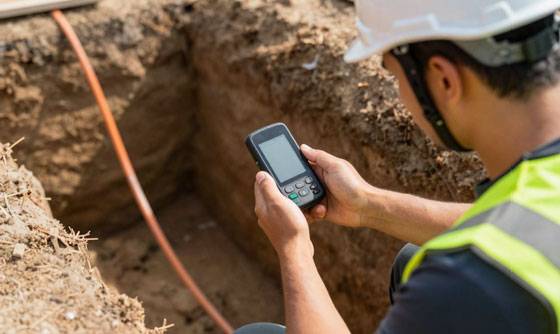
And the manual process is measurably lossy. On the wireless side, VIAVI reports first-time install failure rates as high as 30% ( VIAVI, 2026), with each failure resulting in a repeat visit. On the fiber side, excavation damage is getting worse, not better: the Common Ground Alliance’s 2024 DIRT report logged 196,977 damage reports and a damage index that rose from 94.0 to 96.7 year over year, with failure to notify 811 the single biggest root cause at about a quarter of all events. And the data captured in the field is often wrong from the start — standalone GPS drifts 3–5 meters (Emlid, 2024), enough to put a splice in the wrong yard, while survey-grade RTK brings it to a few centimeters.
The common thread is timing: a variance caught on the tower or in the trench is a five-minute correction, but the same variance caught at close-out, at integration, or after backfill is a truck roll, a re-climb, or out-of-warranty rework. Late-caught errors, unseen strikes, drifting records — each is a failure that real-time, connected capture is built to prevent.
THE SOLUTION
The fix is to architect the site from the network out and move the moment of verification from the office, days later, to the field, right now: capture the work once, check it against the design or standard on the spot, and correct it before the crew leaves. Concretely, that is a small, layered stack in each trade — and none of it is theoretical; every tool named below ships and is in commercial use today. What they share is a single design principle: rather than documenting the work for someone to check later, they check it as it happens.
On the tower
In the trench
The enabler: getting the site connected
None of this runs without connectivity, and a greenfield tower compound or fiber staging yard rarely has a wired drop — trenching fiber for a few weeks of work makes no sense. Fixed Wireless Access solves it: it turns a mid-band 5G signal, already reaching about 90% of the world’s population over existing towers, into site broadband through one piece of self-install customer premises equipment.
None of this runs without connectivity, and a greenfield tower compound or fiber staging yard rarely has a wired drop — trenching fiber for a few weeks of work makes no sense. Fixed Wireless Access solves it: it turns a mid-band 5G signal, already reaching about 90% of the world’s population over existing towers, into site broadband through one piece of self-install customer premises equipment.
A device like Global Telecom’s Titan 5100 (2024) — a 5G-NR router that mounts to a window, pole, or wall, is IP67-rated, and supports dual- SIM/eSIM, Wi-Fi 6, and zero-touch provisioning — gives a non-technician a working site network in hours instead of the weeks a wired drop demands. The CPE is increasingly built to selfinstall and provision remotely, which is why FWA has moved from a consumer story to a practical way to light up any dispersed site fast. Some 28 million FWA units shipped in 2024 (GSA, 2025), and FWA is on track for 350 million connections by 2030. Where one CPE isn’t enough, private 5G or CBRS covers a larger footprint, low-earth-orbit satellite provides backhaul, and an on-site edge node handles latency-critical work like the AR gate. There is even a loop worth naming: FWA capacity is gated by mid-band spectrum — analysts peg the U.S. big three at room for roughly 32 million FWA subscribers (New Street via Fierce, 2025) — so the very cell sites this brief is about building are what make connectivity possible. Sequence it in that order, and don’t buy it all at once. Connectivity comes first, as a budgeted deliverable — an FWA gateway on day one gives the crew the link everything else rides on. Then, the record-keeping backbone, the close-out platform on the tower side, and the mobile GIS on the fiber side, because that captures the work digitally at the source. Then the verification layer — reality capture and AR for towers, computer-vision QA, and OTDR automation for fiber — where truck-roll and rework costs bite hardest. Each layer inherits the layer beneath it, and all layers inherit the network. Provision it first, and the stack pays for itself; leave it to chance, and the best tools in the industry keep riding back out on the next truck.
MICHAEL IRIZARRY
Chief Technology Officer
Global Telecom Engineering | TITANS Network
References
- Bentley Systems. (2024). New study verifies the accuracy of OpenTower iQ digital twin data.
- Botygina, N. (2024). GNSS vs. GPS: What's the real difference? Emlid.
- Common Ground Alliance. (2025). 2024 DIRT Report.
- CTIA. (2025). Summary of CTIA's annual wireless industry survey.
- Ericsson. (2025). Redefining 5G network deployment with Ericsson Site Digital Twin.
- Esri. (n.d.). ArcGIS Field Maps.
- Global Mobile Suppliers Association. (2025). FWA-CPE Vendor Survey: September 2025.
- Global Telecom Engineering. (n.d.). TITAN 5100 5G-NR Window Mount.
- Hardesty, L. (2024). Big U.S. wireless operators have capacity for 16 million FWA subscribers. Fierce Network.
- IQGeo. (2023). Network Manager Telecom.
- IQGeo. (2026). IQGeo signs agreement with German telco UGG to deploy AI-powered field QA for fiber rollouts.
- Mohney, D. (2025). U.S. home fiber deployments top 88M homes passed. Fiber Broadband Association.
- Optelos. (n.d.). Telecom inspection data management.
- Pomarnacki, R., Bručas, D., Jačionis, T., & Plonis, D. (2025). Unmanned Aerial Vehicles for the Monitoring of Telecommunication Towers from an Engineering Approach. Drones, 9(4), 308.
- ProStar. (2025). ProStar announces global commercial strategy with Radiodetection to deliver precision utility mapping.
- Render Networks. (2024). Home Telecom boosts fiber expansion efficiency with Render.
- Sestras, P., Roșca, S., Bilașco, Ș., Șoimoșan, T. M., & Nedevschi, S. (2023). The use of budget UAV systems and GIS spatial analysis in cadastral and construction surveying for building planning. Frontiers in Built Environment, 9, 1206947.
- vHive. (2025). On-site validation: Real-time accuracy arrives at the tower site.
- VIAVI Solutions. (n.d.). Cell site installation and commissioning.
- VIAVI Solutions. (n.d.). FiberComplete PRO: Applications for bidirectional fiber testing.